Graphite Solutions for Tomorrow's Innovations
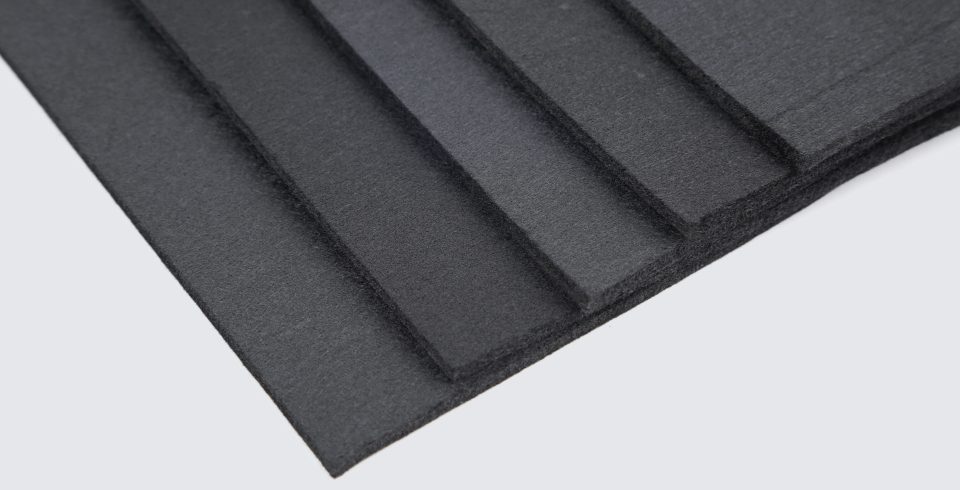
Soft graphite felt is a flexible insulating material for high temperature applications in inert or vacuum environments and is entirely made of carbon fibers. When used as an insulation material for high-temperature industrial furnaces, it can be bound and stitched with carbon ropes woven through special process. Due to its controlled internal structure and electrical conductivity, soft felts can also be used for energy storage like redox flow cells. Soft graphite felts are divided into PAN-based soft graphite felts, rayon based soft graphite felts, and soft felts for battery.
It is a refractory insulating material specially used in high temperature vacuum furnaces and inert gas furnaces with a working temperature of 3992 °F (2200 °C). It features high carbon content, good thermal resistance, low ash content, low sulfur content, good oxidization resistance, easy cutting and installation. If required, it can be purified to less than 10 ppm.
| Model | Heat Treatment Temperature | Carbon Content | Density (g/cc) | Ash (ppm) | Available Thickness (mm) |
|---|---|---|---|---|---|
| CSF-1 Carbonized Soft Felts | 1200 °C | ≥ 97.5% | 0.14–0.16 | ≤ 800 | 3/5/6/8/10/12.7 |
| GSF-1 Graphite Soft Felts | 2200 °C | ≥ 99.5% | 0.12–0.14 | ≤ 300 | |
Notes:
|
|||||
Also known as viscose graphite felt, it is made of viscose based fibers (rayon) that are cured, shaped, and purified through secondary high-temperature processing, and pre-calcined at 4532 °F (2500 °C) to complete the graphitization of the material, making it suitable for working in environments above 2200 °C. It is a soft felt material with good flexibility and compressibility, and can be easily cut into different sizes.
| Model | Heat Treatment Temperature | Carbon Content | Density (g/cc) | Ash (ppm) | Available Thickness (mm) |
|---|---|---|---|---|---|
| CSF-2 Carbonized Soft Felts | 1200 °C | ≥ 98.5% | 0.10–0.14 | ≤ 500 | 3/5/6/8/10/12.7 |
| GSF-2 Graphite Soft Felts | 2200 °C | ≥ 99.9% | 0.08–0.14 | ≤ 300 | |
Notes:
|
|||||
It is specially used as quality electrode material for most energy storage systems like vanadium redox flow battery. It adopts special fibers and weave design, aiming to achieve high liquid absorption and electrical efficiency applications. As continuous production equipment is adopted, it has many unique properties including flat, smooth surface, uniform thickness and overall electrochemical uniformity. Therefore , as electrode, it has excellent performance in Vanadium Redox Flow Battery (VRFB) battery packs with low internal resistance, uelectrochemical quality with uniform activity, good corrosion resistance, slow decay after multiple cycles and high energy efficiency.
| Model | Carbon Content | Ash Content | Bulk Density (g/cm3) | Specific Surface Area (m2/g) | Fiber Peeling Rate (μg/g) | Oxidation Rate (600 °C) | Porosity | Surface Resistivity (mΩ/cm3) | Internal Resistivity (mΩ) | Energy Efficiency | ||
|---|---|---|---|---|---|---|---|---|---|---|---|---|
| GBF-1 | > 99% | < 0.2% | 0.08–0.11 | 2.3–4.0 | 2.0–3.0 | < 2.6% | 85%–95% | 0.165–0.193 | 15.3–26.7 | Current Density 80 mA/cm2 | Current Density 100 mA/cm2 | Current Density 110 mA/cm2 |
| 85.33% | 84.22% | 82.68% | ||||||||||
Notes:
|
||||||||||||
| Length (m) | 10, 20, 50, 100 |
|---|---|
| Width (m) | 1.22, 1.35, 1.42, 1.45 |
| Thickness (m) | 2.2, 3.0, 3.6, 4.2, 4.8, 5.0, 5.6, 6.0, 7.0 |